The Zodiac
24.1
page 1 of 8
Similarities and differences
In preceding texts, we gained an overview of the astrological qualities of the planets in our Solar system.
Our starting point was Earth’s energetic field (14.2), with Earth as its center and place of observation. In the same way, we will now be looking into the Signs of the Zodiac.
For the Zodiac, too, the starting point is Earth (1.2), as again, Earth is both its center and place of observation.
Yet we also found some differences between the two (11.2.a). While the planets form solid, tangible objects moving through space, the Zodiac does not constitute a similar physical reality. The Zodiac is, as we know (1.3), a man-made measuring instrument designed for the purpose of determining our observations of the sky (2.1).
Two centrifuges - two fields
Earth is involved in two movements: its rotation around its own axis and its yearly orbit around the Sun. This means that we find ourselves in a field of multiple rotating forces. Both the Earth’s rotation around its axis and its yearly journey around the Sun, result in a centrifugal force. As we have seen, this force is cast out by a center that generates, through its own rotation, a spherically arranged field around it (14.1, 15.2, 16.1). However, on our Journey Over the Earth, we were in a different position than on our Journey Around the Sun (13.8, 15.2).
A new circumference
In our journey around the Sun, the rotation does not arise from Earth herself, culminating in our free will in the polar axis (15.4), but is related to the movement that Earth is subjected to in her orbit around the Sun. For in her journey around the Sun, Earth is being cast out upon a circumference, taking us along with it (16.1).
However, seen from Earth, it is the Sun that seems to complete this trajectory in a year´s time (18.1). But as we know, this does not correspond to the astronomical reality, and the centrifugal force that Earth is subjected to in her orbit around the Sun, has an effect of its own.
A combination of center and circumference
So in the Earth’s rotation, it is the Earth’s axis that serves as the center or pivot, whereas in her year-long movement around the Sun, the Earth is subjected to the centrifugal arrangement by the Sun (15.2). This means that in its orbit around the Sun, the Earth is not arranging her own field, but is subjected to the Sun’s ordering influence.
In other words:
Because of its own rotation (16.1), Earth (that is, Man) is standing in its own center and is able to administer and potentially re-create its own field (15.4).
In its orbit around the Sun, it is subordinated to the Solar system, which is of a higher order (18.1).
In its rotation around its own axis, Earth is an I-sayer (16.2), an ordering and creative principle. In its orbit around the Sun, however, Earth is a circumferential factor: In the Solar field, Earth is subjected to the Solar centrifugal force and is arranged, as one of the fractions (that is, the planets), into the Sun’s rotating energetic field. The distinct world views that I mentioned in the Introduction (1.0.1 and 1.0.2) are related to these two viewpoints.
Power potential
In the two Earth Poles, the circumference principle and the center principle coincide, or merge. This merging gives these positions their special power potential (15.4). By contrast, Earth’s position in its orbit around the Sun will always remain limited to a circumferential position. So the Zodiacal Signs that the Sun seems to pass through, as seen from Earth, do not have such a powerful potential and are merely a circumferential given (16.1).
The Zodiac
As we know, we have divided the Sun’s orbit, as seen from Earth, in twelve equal segments (1.3); these form our ‘Star Signs’ in the Tropical Zodiac.
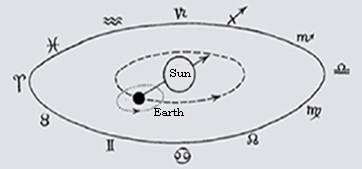
fig. 24.1 The trajectory that the Sun appears to complete in a year is called the Zodiac.
In figure 24.1, we see that at this specific time of year, the Sign behind Earth is Gemini. Yet from Earth, we will see the Sun on the opposite side, where it appears to be in Sagittarius. So we always see the Sun against the background of the opposite Zodiacal Sign. In reality, the Sun does not move along an orbit, for it invariably remains in the center of its own field, in which Earth is merely one of its subordinated fractions (16.1).
index, subjects per page, pictures, blue marked texts, references,